Posts Tagged ‘health’

Speech: Responding to GP-led clinic scrutiny report

January 29th, 2010

I presented this speech in response to a scrutiny panel report I contributed to being presented to full council 28th January 2010. Nobody answered my question at the end of the speech:

I would like to thank Cllr Denise Cobb who was chair of HOSC at the time for agreeing to create this panel after several months of questions on these matters by myself and other members.

I also thank the panel Chair Cllr Alford for his very even handed and co-operative working, as well as Cllr Allen, with whom it always a pleasure to serve with. My thanks to our officer Giles Rossington for his excellent support. I do commend this report to members.

This report is very timely given the continued pressure to further privatise parts of the NHS and package public services off to private businesses.

The panel’s concerns over the tender process favouring larger corporations should trigger alarm bells for all those worried about the future of the NHS. Similarly how such changes are consulted upon with the public was cause for concern with the panel and continue to be a public issue of importance.

These private contracts are riven with problems. The President of the British Orthopaedic Association recently wrote to The Times highlighting grave concerns over their quality control and service levels. A study of one private treatment centre found two third of operations showed poor technique and that after 3 years 18% needed revision operations compared to a 0.9% NHS-wide rate.

Cataract operations at a private treatment centre in Oxfordshire have cost up to 600% over the odds and performed only 93 of 572 contracted procedures for half a year. Meanwhile eye operations in a private contract treatment centre in Portsmouth have cost seven times more than they would on the NHS.

Health service experts the King’s Fund argue these contracts are a drain on Primary Care Trust finances. At a 2008 HOSC meeting a clinician from Brighton & Sussex University Hospitals Trust admitted that the private orthopaedic procedures alone were costing them £2-3 million a year.

The chosen contractor for Brighton’s clinic, Care UK, do have serious ongoing questions over their ability to provide consistent high quality care in our area as well as the rest of the country. In spite… or perhaps because of this… their annual healthcare profit has been in double digit growth for years, including 44% growth in profit for 2009.

Clearly the Conservative Party want more of this kind of privatisation when their 2010 health manifesto states that they aim:

“To give patients even more choice, we will open up the NHS to include new independent and voluntary sector providers…”

We recently learnt that the chairman of Care UK and his wife are giving tens of thousands to fund the Conservative shadow health secretary Andrew Lansley’s office.

So, the question I must ask the Conservative group is…. Is this the kind of privatising corporate ‘greed is good’ politics we can expect if David Cameron wins the general election?

Organic flour has more minerals

January 24th, 2010

Continuing tonight’s health theme, I wanted to post about some interesting data I’ve come upon. I followed up some letters published in the Soil Association’s Living Earth magazine.

The letters continued the debate over the FSA’s controversial report claiming no significant health benefits from eating organic. I’m not a food scientist but the terms and methods of the FSA report seemed destined for a narrow result which could be easily misinterpreted by the media. Though the pretty categorical wording of the FSA’s release helped the media along:

“there are no important differences in the nutrition content, or any additional health benefits, of organic food when compared with conventionally produced food”

What’s odd is that we’ve known for a long time that the mineral content in conventionally farmed produce has been declining. We also know that minerals are vital for maintaining our health. For example this 1997 paper shows how only Phosphorous has escaped significant decline over the fifty years between 1930s and 1980s whilst water content in fruit has increased significantly.

With financial support from some Soil Association members Peter Symonds, a chemist, analysed a variety of flours for their mineral content. Wholemeal, organic UK-grown flours were found to have by far the highest mineral levels for Selenium and Zinc. I’ve copied below the full data and comments from the chemist.

How we grow our food is important not just for the environment around us (e.g. fertilisers polluting our rivers) but for our longterm health. Mineral deficiencies can have long term debilitating health consequences. Sadly the government agency supposed to be championing healthy food is not just ignoring this issue but actively creating the impression the problem isn’t there!

[Full Data]

SELENIUM AND ZINC IN ORGANIC AND CONVENTIONALLY GROWN FLOUR.
January 2010

Hans Lobstein of Brighton and Ian Bowyer of Chelwood Gate, East Sussex,  members of the Soil Association,  have funded an initial consumer survey of white and wholemeal flour for bread making which is sold in England. The  brands Stoneground organic and Marriages organic which were grown in the UK have the highest amount of selenium than conventionally grown.

BRAND AND TYPE                     ORGANIC                   SELENIUM                 ZINC

ug/100 grams        mg/100 grams

Marriages       strong  white               yes                         20.0                         —

Stoneground   strong  wholemeal       yes                         18.0                         —

Marriages       strong  wholemeal        yes                        17.6                         3.4

Marriges         strong  white                no                         15.6                         3.3

Allinsons         strong  wholemeal        no                         11.6                         2.8

Carr                strong  wholemeal        no                         10.2                         —

Dove               strong  wholemeal        yes                         4.2                          —

Hovis               strong  white               no                           3.6                          —

Hovis               strong  wholemeal        no                           3.2                          —

Tesco              soft      white                no                           2.2                         0.8

Morrisons        soft      wholemeal         no                           2.0                         2.6

Dove               soft      wholemeal        yes                          1.0                         2.7

Carr                strong  white                no                           1.0                          —

I have a sneaking suspicion that supermarket own brand Organic will be found to be like the Dove organic rather than the Marriages and Stoneground organic.  The Marriages wholemeal is £ 1.35 per 1.5 kilogram while the supermarket own brand is about £ 1.  I fear that people who think they can get organic at lower price in the supermarket are being short changed overall.

Peter Symonds  B.Sc. C.CHEM. M.R.S.C.

pmsymonds@yahoo.co.uk

http://sites.google.com/site/apexanalytical

[Earlier notes accompanying initial results]

1st December 2009

FOOD STANDARDS AGENCY REPORT COMPARING ORGANIC AND CONVENTIONALLY GROWN FOOD.

The Food Standards Agency has published a report that reviewed some published literature. The report concluded that organic food was not more nutritious than conventionally grown.  Hans Lobstein, a member of the Soil Association,  has funded an initial survey of wholemeal and white flour for breadmaking sold in England. The  brands Stoneground organic and Marriages organic which were grown in the UK have and higher amounts selenium and zinc than conventionally grown, see table.  The Dove flour is derived from wheat grown in Kazakhstan.

The full consumer survey would involve testing other premium brands such as Hovis and McDougal and supermarket own brand Organic flour.

The survey could be further extended to testing for all trace elements.  These can be measured reasonably cheaply using a modern analytical instrument, X Ray Fluorescence,  which measures all trace elements in one go.

A final effort would involve choosing 10 conventional farms and 10 organic farms (matched for wheat variety, soil and climate) and testing the wheat for selenium and trace elements.

300 grams of Stoneground flour per day provides about 56 ug of Selenium while other foods provide about 30 ug per day. Brazil nuts have approx 1560 ug per 100 grams so a few grams of nuts would bring the daily intake to the lower end of the recommended, 100 to 200 ug per day,  all without taking a supplement.  The figure for Brazil nuts has not been found from analysing nuts in health food shops but taken from The Composition of Food by McCance and Widdowson.  Of course,  Brazil is a big place and the composition of nuts may vary across the country.

Peter Symonds     pmsymonds@yahoo.co.uk

http://sites.google.com/site/apexanalytical

Conservative health policy

January 23rd, 2010

I’ve been trying to find the time to post an analysis of the Tory draft health manifesto. But the more I’ve thought about it the less I’ve had to say. Not because it’s marvellous but because the essential points are so simple.

Much of the manifesto is contradictory – calling for less government control in some sections and more in others. Their thinking is muddled at best.

I find it astonishing that despite the NHS being clearly a huge Labour achievement the Conservatives several times over claim they are “the party of the NHS”. What an absurd thing to say. As a Green I feel no need to make such claims, just to offer policies that will improve our wellbeing such as more community-based healthcare and abolishing prescription charges.

The absolutely critical parts of this manifesto refer to that old political favourite of ‘choice’:

“We will give everyone the power to choose any healthcare provider that meets NHS standards.”

“To give patients even more choice, we will open up the NHS to include new independent and voluntary sector providers…”

There we have it. The NHS will be broken up and left to compete with other providers. Private providers I would suggest is where they are going. Because for Tories government provided options are ‘bad’ and in their free-market worldview competition is needed to boost the quality of government services.

We already know that marketisation, competition and privatisation in the NHS thus-far has been hugely expensive, resource intensive, problematic and with very mixed quality outcomes. (Read more: On this blog here and here, plus from the NHS Support Federation & Keep our NHS public)

I’m not entirely surprised by a Conservative push for further privatisation of the NHS, destroying public service and end-to-end treatments without changing providers n-times. But the revelation that the shadow health secretary Andew Lansley’s office is being bankrolled by the Chairman of Care UK makes things even clearer. Care UK are a leading private beneficiary of the NHS privatisation work Labour have done already. I’m sure Care UK can see very significant profits to reap from a Conservative-controlled NHS break-up.

I don’t believe that’s what the majority of British people want to happen, I just hope the manifesto’s weasel words will be exposed before people come to vote.

Naked shoes – Going barefoot style

October 27th, 2009

Women running on the beach

I don’t recall how, but a while ago I somehow ended up reading a post by Tim “Four Hour Work Week” Ferriss on barefoot alternatives. The post and its comments fascinated me. In discussing his experiences of barely there shoes, the post opened me up to a new world of discussion about what shoes might be doing to our feet.

I had been aware for some time of long distance runners going barefoot, particularly those from Africa. But I hadn’t given it much thought as I don’t see myself as much of a runner. But when you consider how marvellous our feet are, it does seem strange that we shore them up with a vast array of padding and strapping in modern shoes. As I read more on the topic it appeared that there was in fact very little science behind many of the technological claims made by shoe manufacturers.

It just seems intuitively and scientifically reasonable that we should let our highly complex and flexible feet to work as freely as possible to spread and balance the pressures of our movements. That current shoe designs are rarely questioned is indicative of the tendency for ‘common knowledge’ to stagnate for too long. Historians of science will be able to point many similar examples with regards to hygiene, blood letting and so on.

We have been paying top dollar for shoes which could well be doing more harm than good, and very few have questioned that. How carefully are the claims of shoe manufacturers verified versus those claims made by pharmaceuticals or even ‘active’ yoghurt products? Back pain costs us huge amounts each year in distress, treatment and time off work. Can shoe manufacturers be trusted on this issue?

My reading took me to New York Magazine’s marvellous article on the barefoot vs shoe debate. The Daily Mail had a surprisingly good piece on the risks of hi-tech shoes. After digesting all these and visiting specialist sites like barefootrunner.com I came to the conclusion that I wanted to try out some ‘barefoot-style’ shoes.

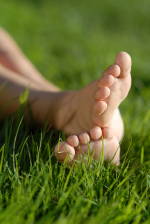
barefeet_in_grass_small

I found there were three likely candidates – the odd-looking Vibram FiveFingers; the Nike Free range and Terra Plana’s VivoBarefoot shoes. The Vibram’s were too wacky for my liking and, according to online reviews, the Nike’s would be too small for my boat-like feet. Terra Plana, luck would have it, have just opened a shop on West Street in Brighton so I popped in to try their Aqua shoes and… wow!

So comfortable, so close to the ground, so… very light! I hadn’t expected them to be so light, suddenly I realised I’ve been lugging extra weight on my feet every day of the week.

I didn’t hesitate to buy them given Terra Plana’s excellent ethical and environmental credentials (but not perfect yet I hasten to add). Walking in the Aquas is a very different experience, much more sensory and stimulating as you feel everything beneath your feet. The thin, extremely flexible sole is just enough to protect but doesn’t feel restrictive at all.

After two weeks of near constant use — but for walking only, nothing more active as yet — I am absolutely evangelical about these very well made shoes. My feet feel like they are stretching outwards and getting stronger. It’s definitely noticeable that over time I’m clomping heel-first less and less.

If we’ve been doing the wrong thing with shoes all this time, what else do we need to seriously re-evaluate? Perhaps our working patterns? Our financial and banking systems? Or perhaps how we elect our politicians? All up for debate, but this shoe story emphasises to me the importance of staying open minded and critically evaluating the terms of any received wisdom.

More evidence that private treatment centres are expensive

September 26th, 2009

Further to my earlier mega-post on health privatisation which focussed primarily on the local Sussex Orthopaedic Treatment Centre, some more news has emerged about the true cost of these privately run NHS centres:

  • The Times reports on a study of hip operations sent to a treatment centre in Weston-super-Mare where two-thirds of operations showed poor surgical technique and 3 years since operation a whopping 18% had undergone or were waiting for a revision operation. The NHS-wide rate for such follow-up procedures is 0.9%. These revision operations are expensive, so on top of the treatment centres being more expensive per procedure, they are also costing taxpayers more due to the remedial work needed.
  • The Times also has a comment piece by Michael Bell, President of the British Orthopaedic Association, which is critical on the lack of data to monitor quality and the disjointed nature of treatment centre operations.

Using the private sector to provide frontline NHS services not only runs contrary to the principle of public service, but again and again is shown to provide worse value and worse quality. Neither Tories nor Labour seem able to see beyond their false sacred cow of private = efficient.

Of course private companies do provide value and quality, look at the Apple iPod, but it’s a completely different market and set of pressures to providing public services. Perhaps if we stopped this trend of calling citizens ‘customers’ we could reset the mindset which seems to want to turn everything into a business.

Fighting for a public-spirited NHS: Stopping the new profit-based contracts of ISTCs and AMPS

December 17th, 2008

December has been extremely hectic with lots of residents group meetings, council work and so on.

This month I’ve spoken to the Planning Committee to oppose the demoltion of the old Royal Alex. I’ve spoken to a very eager green assembly at Brighton & Hove High School for Girls, attended a wonderful ORG Advisory Board meeting, been to the Mayor’s Christmas Reception, attended an Audit Committee meeting and more…

The council meeting on 4th December was a marathon event running from 4pm until after 11pm. The Green Group presented a number of motions all with a common theme of health. (The motions are page 65 onwards in this PDF, with amendments in this separate PDF, the webcast is here).

I presented a motion expressing concerns over the NHS’ use of new contractual schemes that encourage the use of large, profit-driven corporations. I’ve written up my speech notes and the motion below. I provoked a furious response from both Tories and Labour who claimed I misunderstood the NHS where GP practices have ‘always been private’. Yes, they are private firms (partnerships usually) but they work on small scales within their communities. The corporations now coming into the arena are enormous, multinationals even. They can be running clinics and surgeries across the country with GPs, nurses and other staff on contracts, NOT as partners in the business. Not only does this change the quality of care and employment provided, it is already proving to be a more expensive way of providing healthcare. Why should we be spending more taxpayer money for healthcare when a portion of it goes to corporate profit?

I recognise that suppliers for equipment (like MRIs) or drug manufacturers also look for a profit, and sometimes that is a problem. But when we look at the frontline delivery of care being for-profit, I have serious concerns – as do others like Unison and The King’s Fund. I want as much of every taxpayer pound going to helping people and NOT to boosting the balance sheet of some distant corporation who will be taking money away from our local economy.

So on to the arguments in full (which have been updated to take into account some new information following the council meeting):

The motion I presented was about protecting NHS services from corporate profiteering. Its theme was about championing NHS staff and the great work they do. Two new contractual schemes have been created by the Labour government which are cause for serious concerns: ‘Alternative Provider Medical Services’ (APMS) and ‘Independent Specialist Treatment Centres’ (ISTC). These have been couched in terms of ‘innovation’ and ‘choice’ but what they in fact do is open NHS services to corporations instead of the traditional partnerships where profit stayed with the partners.

I know the good doctors, nurses and professionals of the NHS can innovate and they don’t need the threat of these contracts to do so.

I have two main concerns regarding these contracts: The quality of care they provide and the costs involved.

Quality of Care

The Sussex Orthopaedic Treatment Centre, a centre run by Care UK for our local hospital trust under an ISTC contract, has only recently emerged from ’special measures’ from the Healthcare Commission who expressed serious concerns after an inspection.

The Healthcare Commission and Unison have both argued that there is insufficient data to monitor the quality of care at centres run under these contracts. (Sources: Healthcare CommUnison [PDF])

There have also been problems with commercial confidentiality being used to restrict or delay access to information on the centres’ operations and value for money measures. At the last meeting of Brighton & Hove’s Health Overview & Scrutiny Committee we were faced with such a situation (see 3.16 on page 34, for example, in this PDF). I formally requested the information through the Primary Care Trust and I am pleased that most of it has now been released (though it hadn’t been released to the Committee by the Council meeting, however a Tory and Labour speaker both had been directly sent the figures by the Trust ahead of the meeting).

Costs

These contracts are truly extraordinary, breathtaking for many unfamiliar with the details. The operators are paid regardless of the number of procedures they conduct, in the words of a Department of Health officer “Payment would be made in full even if the defined number of procedures had not been undertaken” (48.3 in the minutes). So if they are contracted to undertake 5,000 a year but only do 500, they will be paid as if they had done 5,000 — apparently to help them with the planning and capital investment required. But the corporations aren’t just paid the ’standard’ NHS fee for a procedure used for internal accounting with NHS Trusts, no in fact they are paid a premium of at least 11.2% (See this letter).

No wonder the King’s Fund argue that the contracts are a drain on Primary Care Trusts’ finances (Source). At the last Health Overview & Scrutiny Committee a representative of the Brighton & Sussex University Hospitals Trusts admitted that they were losing £2-3 million a year on orthopaedic procedures alone. This was due to the SOTC taking only the most straightforward procedures (which would cost less than the notional fee) leaving the hospitals to take the complex cases which would cost more than the internal fee they would be paid by the NHS. (See 48.9 in the minutes) So not only was the SOTC being paid regardless of the number of procedures, but it was also cherry picking the most profitable patients leaving the NHS Trust to pick up bill for the complicated cases with co-moribidity. It’s no surprise then that in September The Observer reported that private firms are bidding on £1.25 billion worth of contracts in the NHS for these kinds of centres (Source: Observer). Care UK, who run the SOTC, are the number one provider for these contracts having last year dealt with 170,864 patients through their centres under these contractual arrangements (Source: Ben Bradshaw MP in Hansard). Care UK’s adjusted operating profit increased by 35% in 2007 and in the first half of 2008 by 37% (Care UK Financial Reports). Their Chief Executive earns over half a million pounds a year. Care UK have specifically credited ISTCs as being a source of their revenue growth. A few days after the council meeting at which I presented the motion, Care UK were announced as the preferred bidder for a new city health centre. No wonder Care UK sent so many people to attend our last Health committee meeting! After all the hedged answers here was the same corporation taking on another part of our city’s health services. Despite the growing credit crunch and economic downturn which is putting pressure on tax returns, the government are injecting tax payer money into corporate profit margins. They should instead be focussing on patients and the hard working public sector staff who care for them. I will keep fighting to protect the NHS and patient interest.

I issued two press releases on this here and here.

NOTICE OF MOTION: KEEPING NHS SERVICES PUBLIC

“Since 2006 large private companies have been able to take over or establish GP practices under ‘Alternative Provider Medical Services Contracts’ (APMSC). This new approach, where the need for corporate profit conflicts with patient needs, threatens the trusted model of a partnership of GPs owning and running a surgery for their patients. The city of Brighton & Hove now has five GP practices run by ChilversMcCrea Healthcare. This council notes with concern that in privately run NHS services including GP practices, polyclinics and independent specialist treatment centres (ISTCs):

* Bids from traditional GP partnerships are often undercut by multi-national health companies;

* Doctors work on shorter term contracts leading to increased staff turnover and dramatically less continuity of care for patients;

* Important information on the cost and level of service provided becomes hidden from scrutiny under the cloak of ‘commercial confidentialit

* Proposals are constructed to keep profitable services private while leaving publicly-funded services to pick up the complex, costly cases leaving any cost savings in private hands. UNISON, the King’s Fund and the House of Commons Health Committee have all raised concerns with these new contractual agreements. At the Health Overview & Scrutiny Committee’s meeting on 5th November Brighton & Sussex Universities NHS Trust acknowledged a £2-3 million per annum loss for handling the complex cases left to them by the privately-run Sussex Orthopaedic Treatment Centre, which focuses only on simple cases without co-morbidity.

Given that the Brighton & Hove Primary Care Trust is currently calling for bids on a new GP-led healthcare centre; this council:

* Rejects the creeping privatisation of NHS service;

* Expresses concern over the financial impact of the Sussex Orthopaedic Treatment Centre;

* And asks the Chief Executive to write to Alan Johnson, Secretary of State for Health and Darren Grayson, Chief Executive of the local PCT asking them to cease further APMSC and ISTC contracts and to reject corporate bids for the proposed GP-led health centre.”

Proposed by: Cllr Jason Kitcat Seconded by: Cllr Sven Rufus