Posts Tagged ‘elections’

India’s e-voting machines cracked

April 30th, 2010

Rop Gonggrijp is someone always worth keeping an eye on. He was instrumental in revealing the problems with the Nedap voting machines used in Ireland and the Netherlands.

How he’s part of a team who have publicly demonstrated serious security flaws with India’s electronic voting machines. Time and time again India has been cited as a good example – but the reality was their systems lacked independent scrutiny. Now that expert scrutiny has been brought to bear, problems have been found.

How many more countries have to make the expensive mistake of rolling out e-voting before we all learn that computers and voting are just not well suited for each other.

Read more, and watch the great video at http://www.indiaevm.org

Rop’s post explaining some of the back story

VeTA - a new group campaigning against India’s e-voting, welcome!

(via Ed Felten’s Freedom to Tinker)

Upcoming events in Brighton & Cambridge

April 22nd, 2010

Two events coming up soon which will be of interest to digital rights type people:

  • Debating the Digital Economy Act Thur 29th April
    I’ll be one of the contributors at this debate, organised by Wired Sussex here in Brighton.
  • Internet Voting: Threat or Menace Tue 27th April
    Jeremy Epstein from SRI International is over in the UK and will be giving a talk at Cambridge Uni’s Computer Lab Security Seminar series. I did one of these a few years ago and it was highly enjoyable – the audience were engaged and very generous with their interest.

Electoral Commission Chair re-opens the e-voting question

March 29th, 2010

I’ve just come across a Guardian interview of Jenny Watson, chair of the Electoral Commission, which includes this:

People, she said, should also be allowed to vote online. “There will always be people who will want to vote in person, just as there are people who want postal votes. But you could allow more choice in the system,” she said.

It’s extremely disappointing to hear the Chair of the Electoral Commission, of all people, promoting this kind of view. These kind of facile arguments were being made by Labour ministers 3-4 years ago.

Since then we’ve been on a journey with many MPs, publicly at least, agreeing e-voting is a long way from being ready for consideration, if ever. Most Electoral Commission officers I’ve met have also been taking ever stronger lines against e-voting and e-counting.

I absolutely support the Electoral Commission being more outspoken and pushing more forcefully for reforms that improve the security, accuracy and accessibility of our elections. However I believe, I hope anyway, that Jenny Watson’s comments do not reflect the views of her staff who thus far have been very conscientious (but perhaps too soft-touch) in highlighting the serious risks associated with postal votes, e-counting and e-voting. Online voting being the most risky of all of them!

The risks & challenges of e-voting are laid out in detail in the writings section of this site.

On making the breakthrough and change in the British political system

March 6th, 2010

Political breakthroughs are often surprising and unexpected by many with no interest in their success.

110 years ago today there were no Labour MPs in Parliament. It wasn’t until October 1900 that the first two, Keir Hardie and Richard Bell, were elected. In 1906, thanks to a pact with the Liberals, there were 29 Labour MPs elected. The 1910 election saw 42 Labour MPs returned to the House of Commons. 1924 saw Labour’s first Prime Minister in Ramsay MacDonald backed by 191 Labour MPs. Splits in the Liberal Party gave Labour plenty of room to grow leaving Labour to become established as one of the two major British parties.

History never quite repeats itself exactly, but its lessons are always instructive. Many in the political bubble talk of the parties as if they are inviolable timeless structures which shall always endure. But none of the three major parties currently in Parliament can claim such status. Conservatives, while the oldest, still can only trace their current incarnation back to the 1830s. Labour to about 1899 when various unions and labour organisations decided to contest parliamentary seats. And of course the LibDems only date to 1988 though their origins go back much further than that.

This is a time of incredible social, economic and technological change. Are the parties of the 19th and 20th centuries best placed to represent and serve the citizens of a 21st century Britain? Not necessarily. I’m sure some of their members recognise the new challenges we face such as the LibDem’s Cory Doctorow or Labour’s Tom Watson MP. But structurally I’m not sure those parties are best placed to respond to the new challenges.

When people raise questions about whether it’s worth voting Green given we won’t form the next government or that it’s between Gordon Brown and David Cameron, I respond that change has to start somewhere. Back in October 1900 voters had to vote for what they believed in, that a new party for the labour movement could come of age if given a chance.

Today I believe the Green Party is ready to come of age also. A party that puts social justice, public service and the environment ahead of free trade and trying to keep up with the military superpowers. Labour have lost their way, the Conservatives are divided between emulating ’97 era New Labour and their old hard-right ways whilst the LibDems struggle to resolve what they truly stand for.

We’re on the cusp of a fundamental change in the British political system – I believe a diversity of newer parties are going to have a major role to play in reform. I hope people will trust their vote in Greens to play our part.


Brighton Pavilion: A graphing battleground

February 14th, 2010

Which graph do you think best describes the chances of parties in the fight for Brighton Pavilion constituency? The most recent election, poll or perhaps the last general election in the constituency? In their attempts to woo voters both Labour’s Nancy Platts and Conservative Charlotte Vere are making some interesting choices with their graphs.

Why do election graphs even matter? Because our perverse electoral system means you just need a majority of one vote to win the seat. Many people don’t want to see their votes get wasted by voting for third or fourth parties who don’t have a chance of winning. So we have tactical voting – people voting for the least worst winnable option in their opinion. As a result all the parties vie to show how good their chances of winning really are.

Personally I think you’re only as good as your last electoral test. Yes different voting systems and types of election will influence how people vote – for example, UKIP do vastly better in Euro than local elections. However, for the same place, each election does build a picture of the relative strengths of local parties.

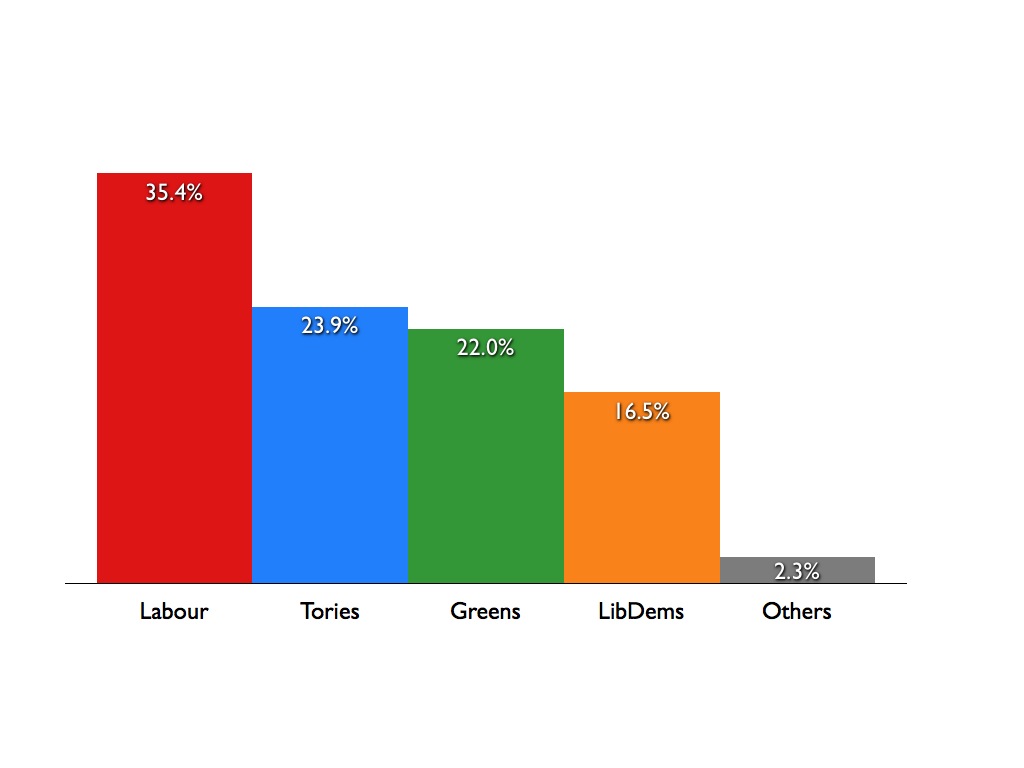
So let’s look at the tale of Brighton & Hove Green Party’s support in the Brighton Pavilion constituency. In 2005, when all the parties had different leaders (Blair, Howard, Kennedy and Greens yet to elect their first leader) and Brighton Pavilion had a different boundary, Keith Taylor brought home a record 22% of the vote for the Greens.

2005 General Election result, Brighton Pavilion

The May 2007 council elections saw us just beat the Tories into first place across the constituency. The December 2007 by-election in Regency ward (which elected me to the council) saw the gap between Greens and other parties widen dramatically. This was repeated in the 2009 Goldsmid by-election, but as it falls outside of Brighton Pavilion is not included here.

May 2007 Council Election results, Brighton Pavilion

December 2007, Regency council by-election result

Next we saw the June 2009 European Elections. Unfortunately we don’t have constituency-level results for these but city-wide Greens came top, beating all the parties for the first time, a feat we repeated in several other cities across the country.

June 2009 European Elections, Brighton & Hove city-wide result

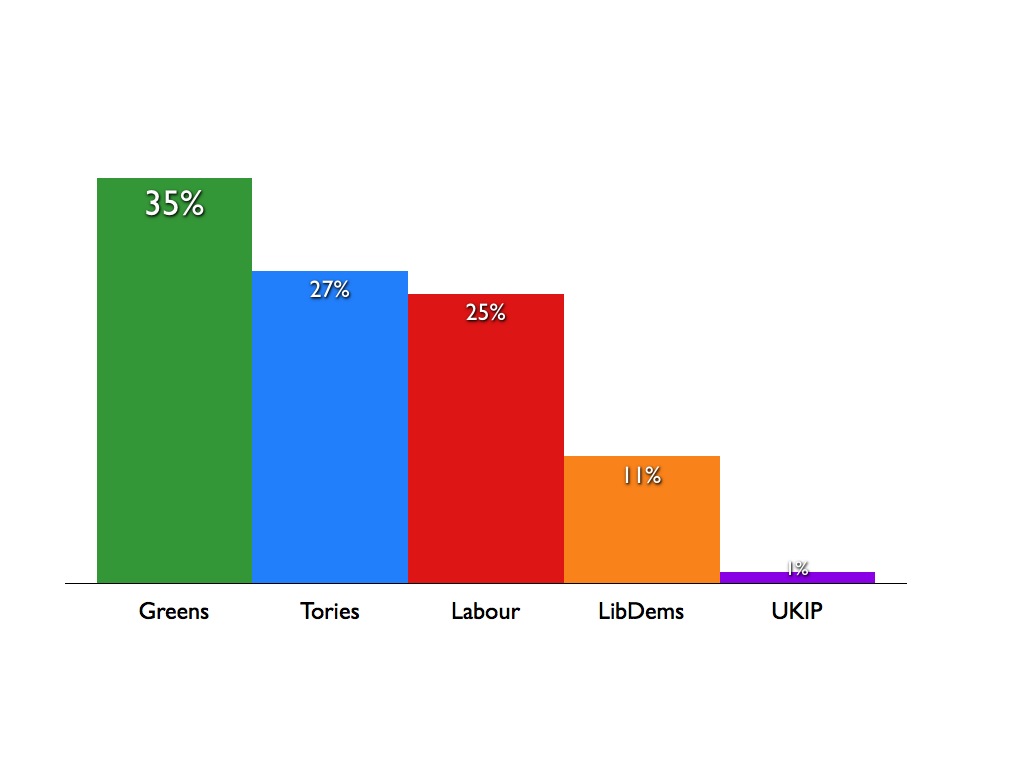
Finally in December 2009 the Green Party commission an ICM poll which showed the same pattern once again – Greens in the lead followed by Tories then Labour.

December 2009 ICM Poll Result, Brighton Pavilion

Some have criticised the poll result – yes it was commissioned by the Green Party – but ICM are a member of the British Polling Council and so are bound by its standards. It’s not like they bucked the trend – the graphs above show results have been pointing in this direction for quite some time. Furthermore the new boundary for Brighton Pavilion includes all of Hanover & Elm Grove ward, which is represented by three Green councillors and has had a strong Green vote for a very long time indeed.

All this to say that the electoral statistics are not easy to address for Caroline Lucas‘ opponents. Still it’s interesting to observe how they handle the challenge. Labour’s Nancy Platts goes for ignoring 5 years of history and suggesting that a Green vote will let the Tories in.

Graph of 2005 General Election result in a 2010 Labour leaflet from Nancy Platts

2005 Election Results, from Nancy Platts' website

This is Nancy’s only option, the most recent graph which shows Labour ahead in the constituency. Sadly, if anything, thanks to our electoral system a Labour vote is likely to let the Tories in this time around. Labour have been trying the old ‘Green vote lets the Tories in’ trick for years in Brighton & Hove, I think people are pretty sick of being told something which evidently hasn’t been held out in recent elections.

(On a side note in writing this post I’ve noticed that different online sources cite the 2005 Green result as either 21.9% or 22.0% — it’s not just a rounding issue, the actual voter numbers differ e.g. BBC vs UK Polling Report. Not a massive difference but just wanted to flag up that I’m aware of it.)

Charlotte Vere treads a rather unusual path with her graphs. First this gem from her most recent leaflet:

2005 General Election result, from 2010 Charlotte Vere leaflet

My scanner may not be the best in the world, but the graph really is that jagged and blocky on the leaflet itself! Notice anything missing from the graph? Yes – Green and LibDem votes! In my view, it really is an extraordinarily misleading graph.

The same leaflet also includes a graph showing remarkable levels of support for the Conservatives:

Pulse GP poll, from 2010 Charlotte Vere leaflet

Pulse, a news rag for GPs, conducted a poll of some of their readers. I’m told by GP friends that the paper is heavily funded by pharmaceutical companies and isn’t considered much of a serious news-source. Regardless, given that most GPs are well into the top tax bracket it’s no surprise they support Tories. But unless there has been a rush of GPs moving to live into Brighton Pavilion, this poll is unrepresentative and bears no relation to what’s happening in the constituency. Is it there for any reason other than to mislead?

While we continue to suffer under our simplistic, winner-takes-all electoral system I’m afraid these kinds of graphing horrors are likely to continue. Whoever people finally cast their vote for, I hope they do so informed by facts and not the graphing skills of the local Labour or Tory activists.

UPDATE: Of course all this talk backed by GP polls from the Tories about being the party of the NHS is deeply misleading as they’re planning to break it up into further private ‘marketisation’ so when they say ‘NHS’ they mean something completely different to what most people understand – more info

Open Primaries: Right diagnosis, wrong solution

October 21st, 2009

10 Downing Street

I was very interested to see the launch of the ‘Open Up’ campaign, with a very slick website and duck-house videos. I would expect nothing less given the people behind it including the immensely capable Becky Hogge, ORG’s former Executive Director.

There is as a whole swathe of campaigning going on at the moment calling for reform in one sense or another. This is extremely encouraging and welcome, it’s wonderful that people are speaking out and getting involved. More power to them.

However, I must take issue with Open Up’s proposed solution. I absolutely agree with their core argument that we need better and more diverse politicians. I think the poor quality of British politics and politicians is an absolutely critical issue at the moment.

In my view party political representative democracy is still the least worst option available to us. If we didn’t have parties we’d have to invent them. All lasting democracies develop groupings of some form another. But we urgently need to re-invigorate parties and our democratic institutions.

Interestingly the Speaker’s Conference in Parliament has recently been touching on these issues too. I took the opportunity to watch online the three party leaders speaking to the Conference: Cameron sounds more dynamic next to Brown but didn’t really say anything more significant. I felt Clegg was the most honest in admitting many of the people they need weren’t coming forward. He also argued that Westminster itself wasn’t the right kind of place to attract the people we need in politics.

We need better politicians

So if we accept that to improve our politics we need better politicians; then it follows that we need a more diverse set of candidates from a wider set of backgrounds. How are open primaries going to do that?

The argument is that because anyone can stand to be a candidate in an open primary, the barriers to ‘real people’ becoming candidates are lowered. People who aren’t party animals, more likely to be ‘mavericks’, will be more likely to stand. This is possibly the case but standing for an open primary then an actual general election doesn’t strike me as a low barrier, many will be put off by that. Furthermore there is no discussion of how to prevent the rich getting a head-start in winning an open primary.

This is one of several practical problems I see with open primaries. Another is that most parties cannot possibly afford to run open primaries where every elector in a constituency can vote for their candidate. The three largest parties are all in debt and the addition of this kind of process in every constituency would be beyond them let alone the smaller parties.

It would also be expensive for potential candidates, particularly if the primaries were truly ‘open’ allowing leafleting and canvassing across the constituency. Such primaries would further extend the length of time a potential candidate would need to dedicate to winning a Westminster seat. If a General Election goes to the wire (as this one looks to) then it can already be a two or three year unpaid commitment before we throw in a whole open primary process.

Finally there is a real risk of voter burnout once the novelty of open primaries has worn out. In a seat like Brighton Pavilion you could be looking at four or five primaries minimum then the General Election itself. There is evidence, particularly from the United States where some citizens vote on dozens posts and initiatives annually, that the more things people are asked to vote on, the less likely they are to vote. There can be too much of a good thing.

These are serious practical problems with open primaries which proponents don’t properly address, I’m not sure they can. There are also political problems with open primaries which mean they won’t deliver what proponents hope for.

Political problems

I believe open primaries will greatly increase the chance of politically naive candidates being selected. I don’t just mean innocent about the ways of politics (though that could be an issue that impacts on their effectiveness as MPs), but that candidates could genuinely not understand or know the range of a party’s policies before being selected.

Imagine a popular local figure gets selected for a party in an open primary then wins the General Election to become an MP by campaigning on, for example, health and policing. This MP is asked by their party whips to vote on a variety of issues in ways they don’t support such as education or civil partnerships. What do they do? Most parties use peer pressure and whips to enforce party discipline and ensure that policies are pushed through (if they are in government). If you vote for a candidate from a certain party shouldn’t you expect them to generally be in line with that party’s core values and policies? How will open primaries, when people of all and no party affiliation have a hand in selecting a party’s candidate ensure some compatibility with a party’s values?

We don’t want to see only the most loyal, grovelling party animals selected as candidates. Absolutely not. But we also don’t want people to become disenchanted because they voted for a certain party only to find the candidate isn’t really in line with what the party represents. Rebels have an important place in Parliament at critical times, but systematic rebellion (pre-planned or unintentional through naivety) is a recipe for chaos, not reasoned legislative work.

Open primaries also don’t alter the electoral reality of safe seats. Unless extremely ineffective or corrupt, most sitting MPs will have an inherent advantage in any selection whether it’s an open primary or internal party process. That’s just how it is, they have the profile and the contacts. Open primaries don’t neutralise incumbency, and we see in the US that it’s still reported as unusual for a sitting politician to lose their party’s selection through a primary if seeking re-election.

We need reform and a new political culture

We need a new culture of politics, one that is more open, honest and transparent. I admire the energy and passion of the Open Up campaign, but disagree with their prescribed solution. Open primaries will be prohibitively expensive for parties and candidates, will burn out voters, could result in candidates not truly representing the party label they stand for whilst failing to address the problem of safe seats.

Changing the culture in our politics requires a more open media, a redesigned educational system, a new constitution, reform of political funding, a recall process and most importantly — a system of proportional representation to elect members to both houses of Parliament. Call for open primaries distracts from these key requirements in the reform agenda.

I believe party politics has a great future ahead of it, if we can increase the number and quality of parties. We need smaller parties that can be more representative of specific groups in our society, more flexible, responsive and less hamstrung by the internal coalitions and simmering disagreement that the large parties of today represent.

This would force greater collaboration, more discourse as opposed to bombastic posturing and a richer, better politics for our country. What do you think?

Norwegian Greens: Excluded from public TV

August 31st, 2009

From Jarle Fagerheim:

Dear Green friends,

We’re having a general election in Norway on September 14, and the Green
party is doing better than ever. Our membership has more than tripled
since last time (2005), the number of visitors to our website is
skyrocketing, and a marvellous team of 8 people are now working
round-the-clock at the Oslo office (last year at this time, it was me
alone!)

The last major hurdle to a Green breakthrough is getting coverage on
national television. The National Broadcasting Corporation has decided
to exclude us completely, there is no such thing as “party political
broadcasts”, paid TV adverts are prohibited by law. Our Minister of
Church and Culture Affairs, Trond Giske, earlier this year promised that
even the non-parliamentary parties were to be given a minimum of
coverage on public television during the campaign. Well, the campaign is
now in its final stages, and nothing is happening.

So I kindly ask you to visit www.democracyinnorway.net and send a
message to Minister Giske urging him to take action. If we can
demonstrate a substantial amount of support from fellow Greens all over
the world, we might be able to get some very good media coverage during
these last three weeks of campaigning.

Please forward this as widely as possible!

Jarle Fagerheim
head of office
Green Party of Norway
www.mdg.no

Problems with the 2009 European Election Count

August 5th, 2009

Errors displayed at the Southampton 2009 Euro count

This post is long overdue, I apologise, by-election campaigns and such like got in the way.

On Sunday June 7th the count for the South East region of the European Parliamentary elections was conducted at St Mary’s stadium, Southampton. In attendance were lots of media as well as candidates, agents and activists along with significant others.

I went along with my wife as one of the Green Party’s candidates and proceeded to experience a very long night with very little information and lots of frustration. What had to happen was for each local authority in the region to count its ballots and submit the results to the Southampton HQ. A few areas were delayed by recounts, mismatched ballot accounts (i.e. ballots lost or in the wrong pile) but there were clearly technical issues in Southampton also delaying matters.

I had learnt a few weeks earlier that the results from local authorities were to be transmitted to Southampton via a ‘secure website’. In essence, as I understand it because I never saw the system or any detailed specifications, returning officers would type the results (twice to verify) into an SSL form which was then emailed to Southampton and also stored in a database. I copy below the full response I received about my enquiries from the Regional Returning Officer Mark Heath.

I had concerns about this setup, what checks were being done and so on. So I ensured local Green agents texted us their results so we could check them against what the system claimed. I felt the returning officers should be collecting out-of-channel verification too via fax or telephone, but they weren’t interested in that idea — too quick and happy to trust the technology sadly.

On the night I saw the technology staffers and returning officer team looking tensely at a couple of computers. No surprise when all the informational displays were showing server errors, exceptions and so on. This left many unhappy candidates and agents who were quick to query the sense of these systems with the returning officer. How I wish they would remember these feelings in the weeks after… every election I observe with technology their are howlings about the problems on the night but a week later most are too busy celebrating their wins or analysising their losses to make the case about how the election was run.

Let’s run through the problems we had with the informational screens:

  • They crashed regularly, especially earlier in the night;
  • The colour coding was confusing as reds, greens, yellows were used in a non-political sense to inform what status various local counts had;
  • They were often difficult to read with too small text or windows not at full size;
  • The updates scrolled by so fast it was impossible to do much than see the top party on the first pass.

You can see the full range of problems screens on Flickr.

It’s worth noting that while they would have been detected in the end, someone could have caused chaos and mayhem by manipulating this results system either just the display (which was basically a webpage on a projector) or the tabulation/counting of results themselves. Given those possibilities I was concerned that the Electoral Commission had not had a role checking this software and that fairly serious failures were happening on the night.

I’m a technologist. I spend all day with computers, programming them, using them, talking about them. I remain deeply concerned by the use of technology in elections especially when it is done without the proper rigour of testing and certification. Things can and do go wrong, especially for high pressure events like elections.

I don’t think we would have been any worse off if in Southampton a fax had been received from every count with the results which was manually checked against the online results. These could have been tabulated in a public way the way ballots are checked. We have to be more cautious before jumping both feet first into a computer-only solution.

Responses from Regional Returning Officer to my queries prior to election day:

The system is secure, and has been fully tested already which has shown it to work fully  -and indeed without the potential errors that a system that requires data to be managed via Phone / FAX & re-inputted on several occasions – but I will let you know chapter & verse shortly. Thanks.

UPDATE: Adrian Windisch, Chair of Reading Green Party, writes to say Thanet Borough Council’s website reported 6,001 Green votes, but the South East region count recorded 3,001 votes. This was later corrected on the Thanet website following Adrian’s enquiries. Which goes to show these things do need checking!

….
On your question, the suppliers have advised us that:

“The European Regional Returning Officers Managements System (ERROMS) application along with the application databases reside on high powered servers within defined security level segments.

All hardware devices within ERS’ live hosting environment are duplicated to facilitate a highly redundant and resilient network. Market leading security appliances at the perimeter provide rich stateful inspection of traffic flows protecting the web servers from malicious activity. A further layer of security has been added to the servers using Anti-Reconnaissance software. The web servers are load balanced to enhance performance, should one of the servers fail the other will automatically service the entire load until the offending device is returned back to its functioning state. The database servers are hosted within an isolated network forcing database requests to be inspected by the firewall a second time. All databases using live replication software are replicated to a secondary offsite server which provides redundancy and disaster recovery.

Databases are further protected with database level passwords and access-granting security features. Intrusion Detection and Prevention Systems detect suspected efforts at server intrusion. A 24×7 automated monitoring system using specially designed intrusion detection parameters detects and blocks attempts at security breaches. The system logs all intrusion attempts, and these logs can be preserved to aid in prosecution of attackers, should such action be warranted.

All servers have been hardened to remove any non-essential code and are subject to strict operating system security such as permissions and password access. The hosting network and Web Applications are scanned weekly to ensure our web sites, servers, and internet-connected devices are free of known vulnerabilities. It also determines whether our site passes the SANS Top 20 Internet Security Vulnerabilities list as defined by SANS, the FBI and FedCIRC.”

The key elements to reduce error include;
• Initial entry of  results are submitted twice to reduce keying errors and are only accepted when both sets of results match.
• Additionally, submitted data is emailed to provide an electronic paper trail that can be used for confirmation of data submitted by both the RRO and LRO’s
• Declaration of Local Results is generated from the system with results authorised by the RRO and can be checked by the LRO’s against local records to ensure that the submitted values are correct.

Effectively this means the submitted results by the LRO are checked 3 times before local declaration and will help eliminate the transposing of figurers received via phone/fax which has been experienced before.
There are now 6 regions using this. We wouldn’t be doing it unless we were satisfied that it was secure. The risk of transposing figures data is one of the reasons for moving away from the phone/  fax route, although that remains available as a contingency / fall back option.

The complexity of e-voting

November 5th, 2007

It’€™s well known that I’€™m opposed to the introduction of e-voting and e-counting in the UK. This is fundamentally because the technology of today cannot deliver on the unique requirements of democratic elections. Elections require secrecy, accuracy, anonyminity and verifiability. This is an incredibly difficult combination of requirements to meet. Banks or online shops don’€™t meet all the requirements – while others may not know what you bought (secrecy) unlike voting your identity is known to the bank or vendor (anonyminity) so that they can deliver their services and check if you are a fraudster. By checking your bank statements you have an element of verifiability not available in voting.

While many very clever people are working hard on a variety of cryptographic solutions to these problem, I think they miss the point. I’m not saying that their work isn’€™t interesting or clever. It€’s just that their proposals are usually very complicated and hard to administer. The result is that they suffer from a lack of transparency as voters and candidates struggle to understand what is going on. Recent demonstrations of promising cryptographic election methods descended into farce when the inventors couldn’€™t administer their mock elections due to the complexity of the procedures.
I just can’t see any pressing, convincing reasons to be spending large sums of money and introducing new levels of risk to our voting systems by making them electronic. There are bigger, more important challanges such as climate change or caring for our aging population.

A hundred years from now there may well be a technology or a theoretical breakthrough which makes it trivial to implement e-voting that conforms to the requirements of secrecy, accuracy, anonyminity and verifiability. I can’€™t see such developments on the horizon, but I can’€™t rule them out. I very much doubt I’€™ll still be here in a century, but I rather do hope we’€™ll have been wise enough to focus our brightest on more pressing issues than just making our votes electronic.

(Cross-posted from Our Kingdom)